The Price of News: Paywalls Saved the Big Papers and Left Local News Behind
How we reportCorrectionsWho pays for thisSend a tip
For about 140 years, advertisers paid for most of America's news. That deal is over. Readers are now asked to pay outlet by outlet, most of them won't, and the money that's left flows to a few national brands. Meanwhile, hedge funds and debt-laden chains own much of what remains of local news, and about 50 million Americans have little or none.
Who used to pay for the news
Advertising already paid about half of U.S. newspaper income by 1880 and 64% by 1910. It stayed the majority through the radio era, the television era and the early web, peaking at 82% of newspaper revenue in 2000. Radio and TV news were free to the audience, paid for by advertisers and, for public stations, partly by government.
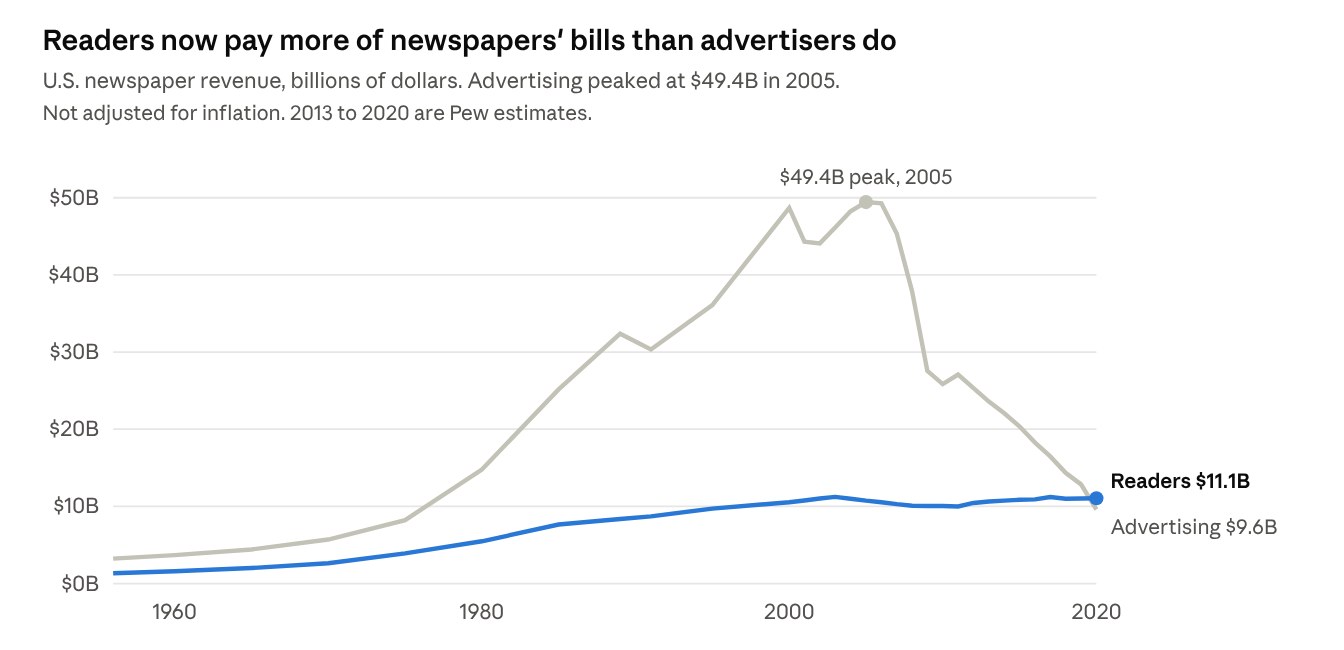
The web broke that model. Classified ads moved to Craigslist and job sites, and display advertising moved to Google and Facebook. Newspaper ad revenue peaked at $49.4 billion in 2005. By 2020 it had fallen to $9.6 billion, below the $11.1 billion readers paid. Readers became the main source of newspaper money again, not because they were paying more, but because the ad money had vanished.
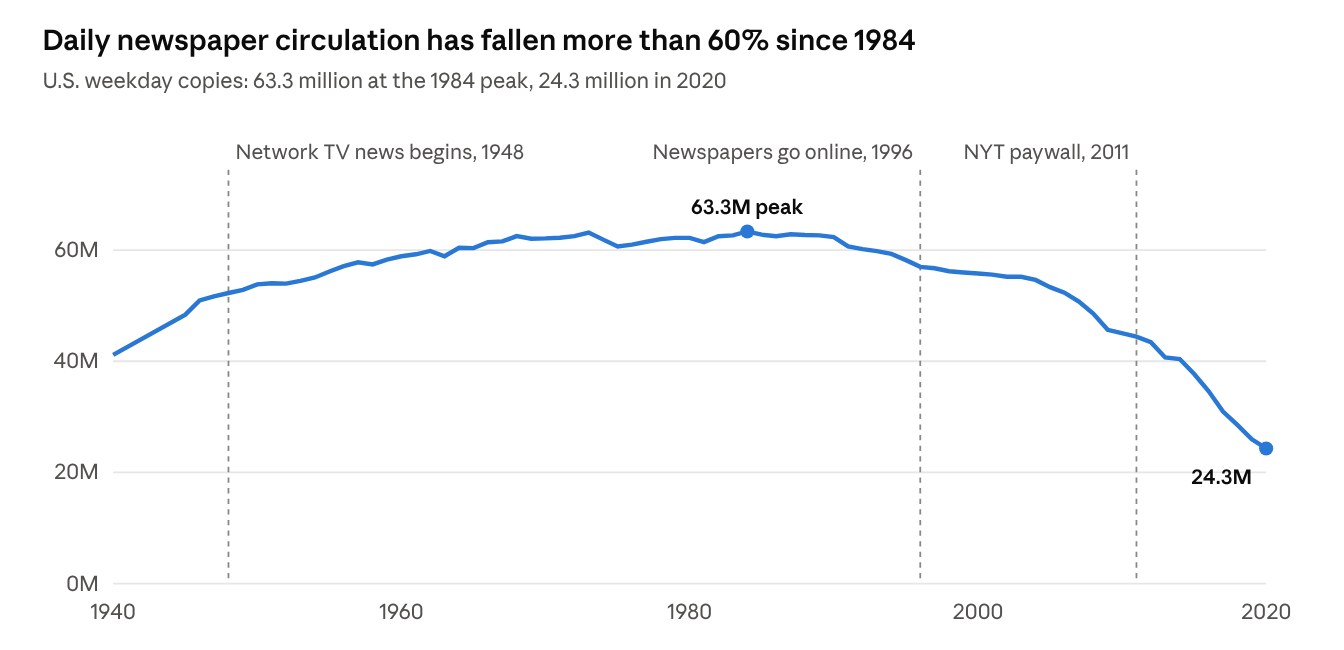
Print readership fell with it. Weekday circulation peaked at 63.3 million copies in 1984 and was down to 24.3 million by 2020.
The paywall winners
Subscriptions are now the main business model, and they work mostly for a handful of national brands. The New York Times had 13.2 million digital-only subscribers at the end of September 2026, up 12% in a year. The Wall Street Journal had about 4.5 million. The Times sells far more than news: games, recipes, sports and product reviews. By late 2025, about 35% of its subscribers weren't paying for the core news product at all.
The 62 English-language publishers with more than 100,000 subscribers have about 54 million between them, according to Press Gazette, but most of that growth is at the very top. USA Today Co., the former Gannett and the country's largest newspaper chain, has about 1.4 million to 1.5 million paid digital subscribers.
Most people won't pay
Only 17% of people across 20 countries paid for online news in 2024, a figure unchanged for three years, according to the Reuters Institute for the Study of Journalism. Among people who don't pay, 57% said they wouldn't pay anything. In the U.S., 46% of subscribers pay less than full price, and the average subscriber holds two subscriptions. Few add a third for the local paper.
The result is a two-tier system. Reporting behind a wall goes to people who can afford several subscriptions. Everyone else gets free social feeds and, increasingly, AI summaries.
The free traffic is drying up
Paywalls depend on free visitors from search and social media, a small share of whom become subscribers. That pipeline is shrinking. Google search referrals to U.S. publishers fell 38% in the year to November 2025, according to Chartbeat data cited by the Reuters Institute, as AI-generated answers replaced clicks. News leaders expect another 43% drop over three years. ChatGPT sends publishers 0.02% of their referral traffic.
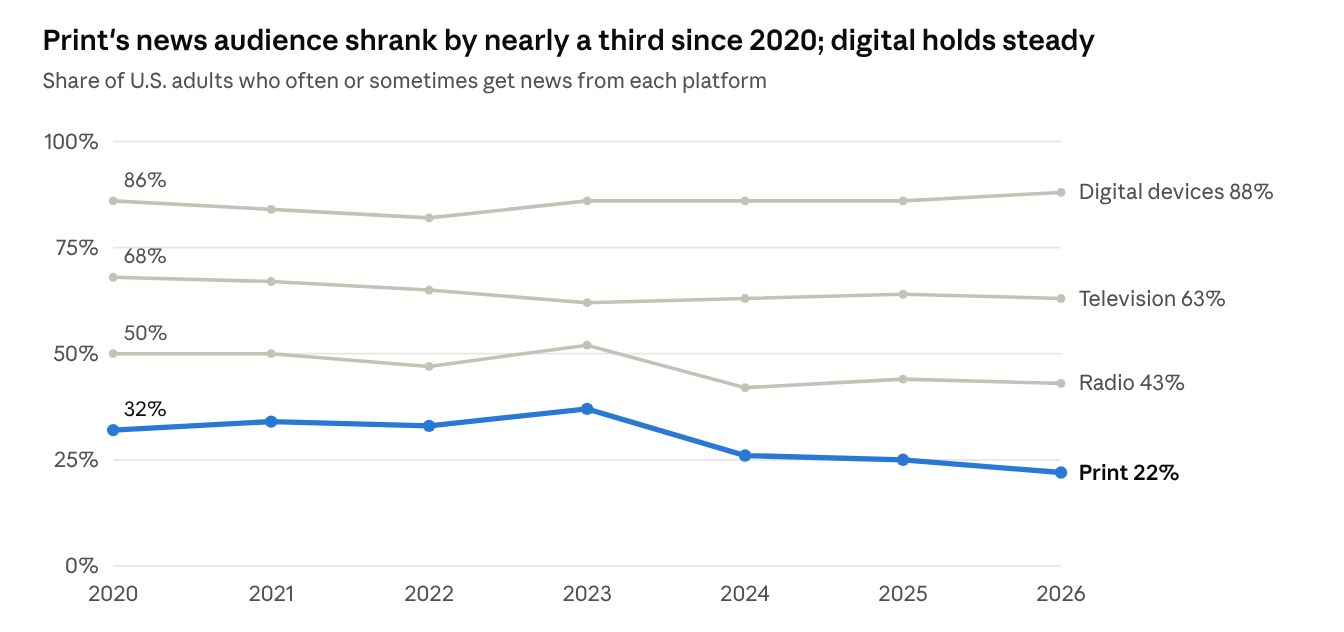
Social and video platforms have now passed news websites as the most-used way to get news online, 54% to 51%, the Reuters Institute found in 2026, with trust in news at a record low of 37%. Web traffic to the 100 largest U.S. newspapers fell more than 45% over four years.
Who's left to do the reporting
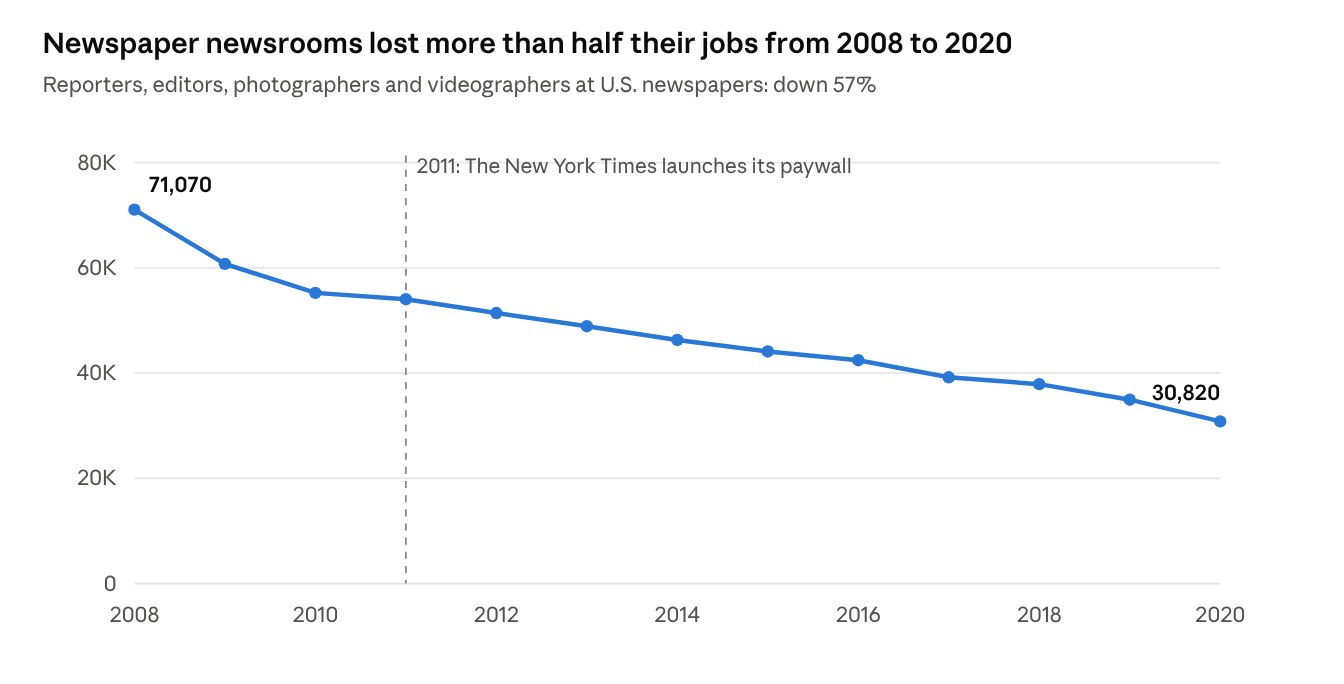
Newspaper newsrooms were shrinking before paywalls arrived, and paywalls didn't stop it. Federal survey data analyzed by Pew show newspaper newsroom jobs fell 57% from 2008 to 2020. Digital-only outlets added about 10,000 newsroom jobs over the same years, nowhere near the roughly 40,000 that newspapers lost.
Medill's 2025 State of Local News report counts 213 U.S. counties with no local news source, up from 206, and 1,524 more with only one. Newspapers closed at a pace of more than two a week, 136 in a year, and the industry has lost more than three-quarters of its jobs since 2005. More than 300 local news startups launched in five years, 80% of them digital-only, but most are in metro areas, not the rural counties that lost their papers.
Wall Street buys the press
Since 2010, hedge funds and private equity firms have become some of the biggest owners of American local news. The pattern repeats: buy a struggling chain cheaply, often out of bankruptcy or with borrowed money; cut the newsroom and consolidate printing, design and editing across many papers; sell buildings; and raise prices on the most loyal readers.
- Alden Global Capital took control of MediaNews Group, owner of the Denver Post, in 2010. It bought Tribune Publishing, owner of the Chicago Tribune and eight more big-city dailies, for about $633 million in 2021. In the first six weeks of buyouts that followed, the NewsGuild counted union newsroom staff down about 22% at the Chicago Tribune and The Morning Call. In May 2026, Alden's Chicago Tribune agreed to buy the suburban Daily Herald.
- Chatham Asset Management, a New Jersey hedge fund, bought McClatchy, owner of the Miami Herald, the Kansas City Star and about 30 papers in all, out of bankruptcy in 2020 for about $312 million, mostly by converting McClatchy debt it already held.
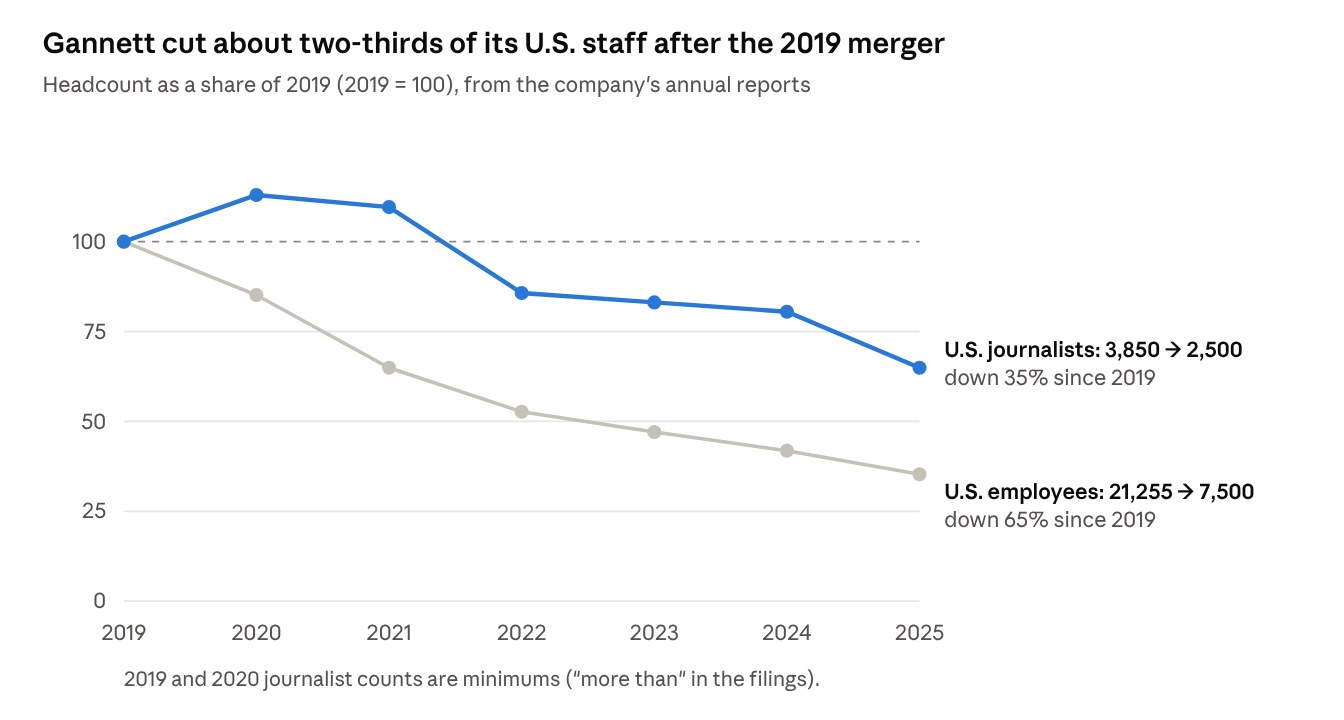
- GateHouse bought Gannett in 2019 with a $1.8 billion high-interest loan from the private equity firm Apollo, promising about $300 million a year in cost cuts. Its own annual reports to the SEC show the combined company cut its U.S. workforce by about two-thirds and its U.S. journalists by about a third through 2025.
A study of 1,610 daily newspapers by economists Michael Ewens, Arpit Gupta and Sabrina Howell found that after private equity buyouts, papers employed fewer reporters and editors, covered less local government in favor of national news, and saw participation in local elections decline. Those papers were somewhat less likely to close outright, and their digital readership grew.
The same consolidation has spread to broadcasting. In March 2026 the FCC approved Nexstar's $6.2 billion purchase of Tegna, combining 265 local TV stations in 44 states and Washington, D.C., and waived federal ownership limits to allow it. Eight states and DirecTV sued to block the deal. In August 2026 the FCC approved Alden president Heath Freeman's 31.86% voting stake in the radio chain Cumulus Media after its bankruptcy.
The algorithm question
Critics of the platforms argue that ranking algorithms have become journalism's most powerful editors, and that they edit for engagement rather than accuracy. A 2017 study in the Proceedings of the National Academy of Sciences found each moral-emotional word in a post raised sharing by about 20%. Twitter's own researchers reported in 2022 that its algorithm amplified right-leaning politicians more than left-leaning ones in six of seven countries studied. When Meta pulled news from Facebook and Instagram in Canada in 2023 rather than pay for it, Canadian outlets lost 85% of their engagement on those platforms.
The counterpoints are serious too. In Meta's 2020 election studies, published in Science and Nature in 2023, switching people to a chronological feed showed them more posts from untrustworthy sources and had no measurable effect on polarization. The Twitter researchers couldn't say why the amplification happened. And outrage-driven news is older than any algorithm: yellow journalism, partisan papers, talk radio and cable news all came first. Search and social also let small outlets reach readers a newsstand never could.
What's been tried
Governments have tried two main approaches: making platforms pay, and paying for journalists directly.
| Where | What | What happened |
|---|---|---|
| Australia | News Media Bargaining Code (2021); News Bargaining Incentive (2026) | Pushed Google and Meta into deals with publishers. The 2026 law charges platforms that won't make deals a 2.5% levy on local ad revenue, offset by what they pay small and medium publishers. |
| Canada | Online News Act (2023) | Google pays about C$100 million a year through a publishers' collective. Meta blocked news instead. |
| California | Deal with Google (2024); Community NEWS Act (2026) | The Google deal promised $175 million over five years, but only $20 million was put up in the first round, and none had reached outlets by January 2026. The new law gives refundable credits of $15,000 to $20,000 per journalist. |
| New York | Local journalism jobs credit | A 50% credit on the first $50,000 of a journalist's salary, capped at $300,000 per outlet; $30 million a year. |
| Illinois | Local Journalism Sustainability Tax Incentive (2024) | Up to $15,000 per journalist, plus 120 days' public notice before a local outlet is sold. |
| New Mexico | 2026 tax package | $4 million a year for five years in employment credits, plus a local news fellowship. |
| New Jersey | Civic Information Consortium (2018) | A state-funded nonprofit that makes grants to local news projects. |
| Utah | SB 287 (2026) | Taxes the biggest sellers of targeted ads at about 4.7% to 4.85% starting in 2027. |
| Congress | Journalism Competition and Preservation Act | Would let publishers bargain jointly with platforms. Dropped in 2022, reintroduced in 2023, still not passed. |
Direct credits and fellowships have proved easier to pass and harder for platforms to dodge. Platform-payment laws brought in money where companies agreed to pay and backfired where they refused. None of these laws require outlets to drop their paywalls.
Ohio has done none of it
Ohio has no local news law. Its one recent move went the other way: in the 2025 budget, the legislature voted to end newspapers' 90-year exemption from sales tax. Gov. Mike DeWine vetoed it.
Every policy other states use is available to Ohio: a refundable credit for local journalists like New York's or California's, a reporting fellowship placing early-career journalists in underserved counties, an independent civic information fund like New Jersey's, rules steering state public-notice and ad spending to Ohio outlets, and Illinois-style advance notice before a local paper is sold to a chain or a fund.
In the Miami Valley, the Dayton Daily News has stayed with the Cox family for most of its 128 years, a family owner rather than a fund. Even so, it has closed its Franklin printing plant, stopped printing on Saturdays, and in 2019 was briefly sold, along with Cox's TV and radio stations, to the private equity firm Apollo before Cox Enterprises bought the papers back in 2020.
Disclosure: The Despoiler is a free, locally owned, one-person news outlet in Dayton, funded by reader support and local sponsors. It is part of the business this story covers.
Sources
- Gentzkow, Glaeser and Goldin, "The Rise of the Fourth Estate" (NBER)
- Pew Research Center: Newspapers fact sheet
- Pew Research Center: Newspaper newsroom employment, 2008–2020
- Pew Research Center: U.S. newsroom employment has fallen 26% since 2008
- Pew Research Center: News Platform Fact Sheet
- New York Times Co.: third-quarter 2026 results
- Press Gazette: Biggest subscription news websites
- Reuters Institute: How much do people pay for online news?
- Press Gazette: Online news subscriptions stagnate
- Press Gazette: Google traffic to publishers down (Chartbeat, Reuters Institute)
- Nieman Lab: Digital readership for local newspapers is cratering
- Medill: News deserts hit new high (2025)
- Alden Global Capital (Wikipedia)
- Poynter: Alden buyouts at Tribune Publishing (2021)
- Medill Local News Initiative: Paddock sells the Daily Herald (2026)
- MediaPost: Chatham acquires McClatchy
- Indianapolis Business Journal: GateHouse–Gannett cost cutting
- Gannett Form 10-K, 2019 and USA TODAY Co. Form 10-K, 2025
- NBER: Local Journalism under Private Equity Ownership
- AP via WTOP: States and DirecTV sue over Nexstar–Tegna
- Radio Ink: FCC approves Cumulus ownership transfer
- NYU CSMaP: Emotion shapes the diffusion of moralized content (PNAS 2017)
- The Conversation: Twitter's algorithm study (PNAS 2022)
- Tech Policy Press: The Meta 2020 election studies
- Media Ecosystem Observatory: Meta's news ban in Canada
- AdNews: News Bargaining Incentive passes parliament
- CalMatters: Local news tax breaks
- Rebuild Local News: 2026 state legislative roundup
- RSM: Utah enacts targeted advertising tax
- MediaPost: Ohio governor vetoes end of newspaper sales-tax exemption
- Dayton Daily News (Wikipedia)
AI tools gathered and sorted the records for this story, checked the math and wrote a first draft. Rich Vandall rewrote, checked and edited it. How we report.