Bury the Landfill, Not the Legend
Dayton once had one of the fastest half-miles in racing. It has been under a dump since the 1980s. Here is the case for a new Dayton Speedway, and where it could go.
For almost half a century, Dayton had a racetrack that told drivers whether they were ready for Indianapolis. Today the spot on Soldiers Home–West Carrollton Road is a landfill, and the only hills left are piles of debris, as the Dayton Daily News put it on the track's 80th anniversary. This city should have a speedway again. Here is what we lost, and where a new one could go.
What Dayton lost
- It was built to put Dayton on the map. Civic leaders formed the Dayton Speedway Corp. in 1933 to make the city a racing center, according to the Dayton Daily News archives. The plan was a $12,000 dirt track, five-eighths of a mile long.
- It opened June 3, 1934, as a flat, D-shaped dirt oval. Ken Fowler won the first race, and Dayton's own Mauri Rose, a future Indy 500 winner, finished second (Wikipedia).
- Then it got fast. It was paved in 1936. Frank Funk, who built Winchester Speedway, took it over and by 1939 had rebuilt it as a high-banked half-mile, plus 210 feet, with turns banked 31 degrees. Legend says he buried old trolley cars to build up the banks (Wikipedia; Dayton Daily News, July 6, 1975). On July 7, 1968, Sonny Ates set a world record for sprint cars here, then beat his own time on Aug. 3 with a 16.81-second lap, 107.079 mph. That same year Benny Parsons set the stock car qualifying record, 18.38 seconds, then won the 200-lap ARCA race (Dayton Daily News, July 6, 1975).
- It was one of "The Hills." With Winchester and Salem in Indiana, it formed a trio of high banks that served as a proving ground for the Indy 500. A.J. Foyt, Parnelli Jones, Bobby Unser, Eddie Sachs, Lee Petty and Benny Parsons all raced it. Dayton drivers Harold Smith and Dick Freeman went from these banks to the first Daytona 500 in 1959 (Dayton Daily News).
- It made stars. In 1949 a young Troy Ruttman was nearly unbeatable here and earned the nickname "King of the High Banks." Three years later he won the Indianapolis 500 (Dayton Daily News, July 6, 1975). Dayton's Joie Ray, the first Black driver to receive a sprint car license from the American Automobile Association, raced the area's tracks, Dayton among them (Dayton Daily News, April 18, 2008).
- It was dangerous. Its worst day was April 20, 1952. Gordon Reid's sprint car jumped the rail in the north turn and crashed into the base of the grandstand. Reid died of his injuries, a special track policeman and two spectators were killed, and about 50 people were hurt, the Daily News reported in 1975 (Dayton Daily News, July 6, 1975). Later that year Jim Rigsby was launched off the turn 3 banking and landed in a cabbage field 200 feet away (Wikipedia).
- Nine people died there. The fan site Dayton Speedway Lives keeps a tribute to the nine people who lost their lives at the track (Dayton Daily News, April 18, 2008).
- It drew crowds. About 13,000 people packed in to see Indianapolis champ cars make their only appearance here, won by Eddie Elisian, and 12,000 saw NASCAR's Grand National race on Aug. 20, 1950 (Dayton Daily News, July 6, 1975; Racing-Reference). The first Dayton 500 ran in 1953 under John Marcum's Midwest Association for Race Cars, the group that became ARCA. George Flanagan bought the track in the late 1950s and brought in Harlan Fengler, the Indy 500's chief steward, to help promote it; the banked turns were cut down by 6 feet in that era (Dayton Daily News, July 6, 1975; Wikipedia). By 1965 it had lost its USAC sanction over unsafe conditions and closed.
- The Earl Baltes years. In April 1967, Eldora Speedway founder Earl Baltes announced he would spend about $60,000 to get Dayton Speedway ready for top racing that summer. His company, B&M, leased the track through 1980 from Flanagan's Dayton Speedway corporation; Baltes owned 51 percent and ARCA head John Marcum owned the rest. A Marysville contractor was hired to resurface the track from the guardrail 40 feet down, and USAC sprint cars and ARCA stock cars were booked. Baltes, who played saxophone in his own dance band, told the Daily News he got hooked on the racing business in part because he once couldn't buy his way into a packed Dayton Speedway (Dayton Daily News, April 23, 1967, p. 2-D). Under Baltes the gate stayed tough: when NASCAR founder Bill France Sr. showed up in 1969 to recruit ARCA drivers for Talladega, the ticket taker didn't know him and charged him admission. France was so impressed that he offered Baltes a standing job in Daytona (Dayton Daily News). The Baltes reopening produced the track's fastest laps ever, and its last great run.
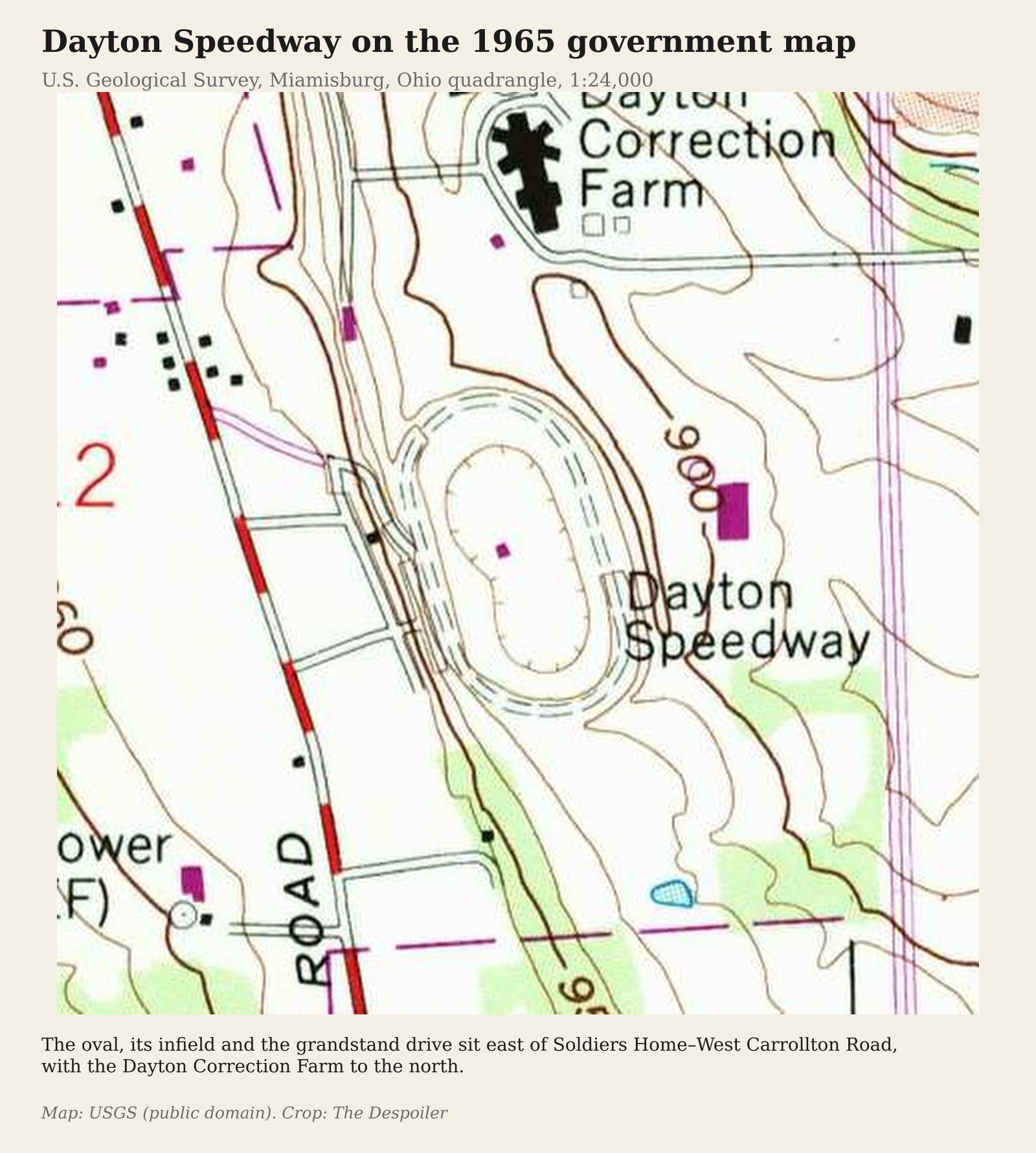
Map: USGS (public domain).
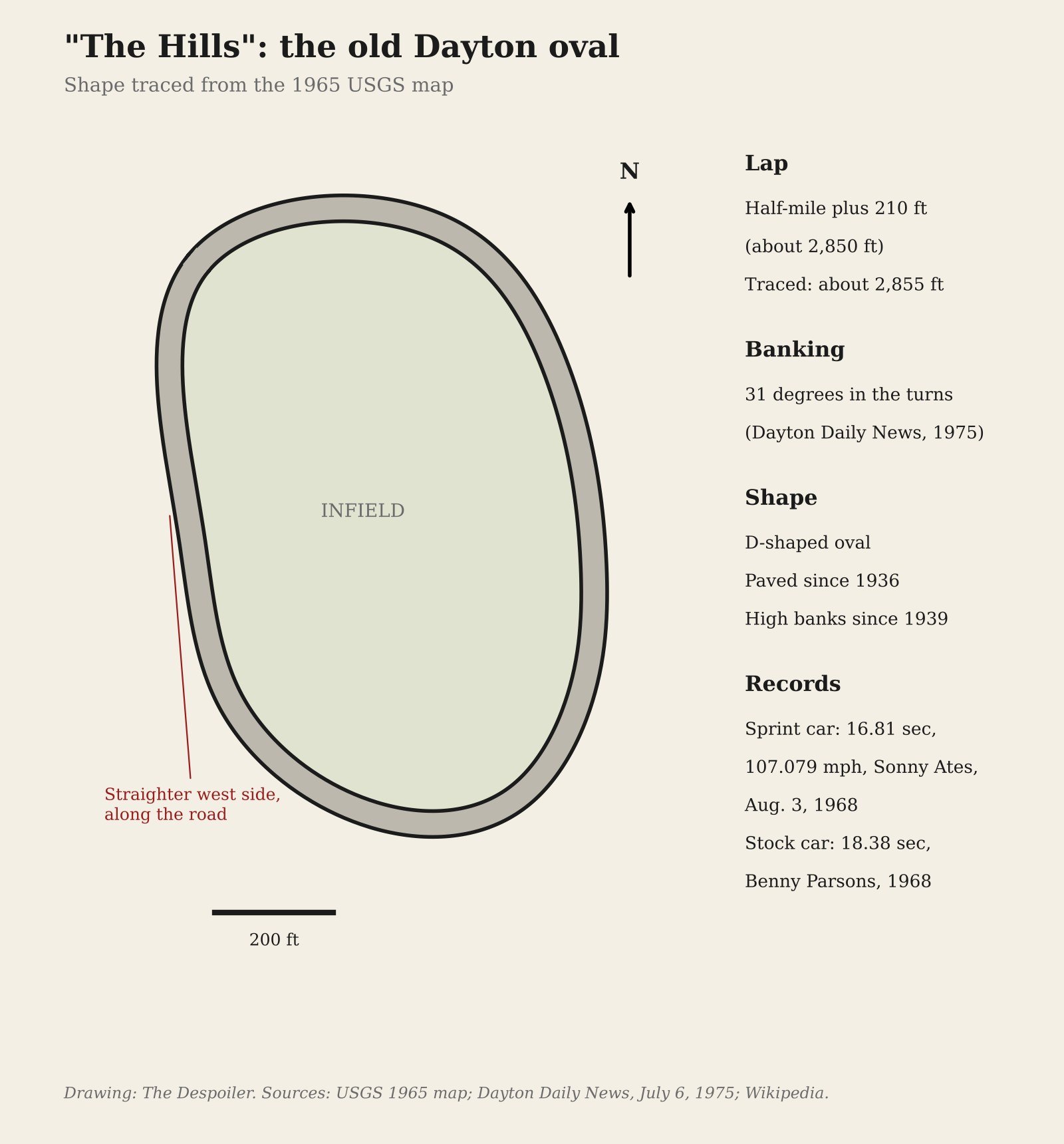
Drawing: The Despoiler, traced from the 1965 USGS map.
How it died
After 1968 the money ran out again. The Daily News dated the closing to 1970; other accounts put it at 1971 (Dayton Daily News, July 6, 1975; Dayton Daily News). After a seven-year legal fight over the 33-acre property, a court ordered it sold in 1973, and Sportservice Corp. of Buffalo, N.Y., bought it for $50,000 plus back taxes.
Then came the rescue. In 1975 Don Flory, a 28-year-old former stock car driver from New Carlisle, quit his job and sold his house to lease the track (Dayton Daily News). He and a crew of 6 to 12 volunteers worked 10- to 12-hour days, seven days a week, on a $60,000 budget. They cut down 25-foot trees growing out of the grandstand, rebuilt its rotted beams with lumber from the portable lanes of a bowling tournament at the Convention Center, and replaced 53 guardrail posts (Dayton Daily News, July 6, 1975). The first race under Flory's group ran Aug. 10, 1975, and about a half dozen followed that season.
The pavement broke them. By April 1976 a Dayton-area company had repaved nearly the whole track for $50,000 to $75,000, and 22 events were booked. The new asphalt soon flaked in the corners. During a June 1976 late-model race, flying chunks broke car windshields, and after the surface broke up again at an August USAC sprint race, the rest of the season was canceled. Fewer than a dozen events ran. In 1977 USAC canceled its two midget dates, citing unsafe track conditions, while the owners and the paving company argued over the repair. USAC's sprint car supervisor, Dayton's Russ Clendenen, said he knew the track could draw crowds and make money, but the cars were running too fast to take the chance. By then Flory's group had grown from a handful of stockholders to almost two dozen (Dayton Daily News, May 1, 1977).
The track reopened in 1979 as Greater Dayton Speedway.
It closed for good after the 1982 season because it had no liability insurance. From 1986 to 1994 the site was a landfill, then it was capped with clay (Wikipedia). The lesson is plain: the track didn't die for lack of fans. It died for lack of money, insurance and a surface that could hold up to 31-degree banks.
What's there now. No building stands where the oval was. The ground sits in a construction-and-demolition debris landfill at 1550 Soldiers Home–West Carrollton Road, owned by S.R.I. Inc., a company of Dayton-area contractor Steve Rauch. Health inspectors repeatedly ordered cleanups there in 2016 after finding waste a debris landfill isn't allowed to take, from furniture to a burnt trailer, and in 2018 they found possible leaching into groundwater (Dayton Daily News). Ohio's attorney general indicted Rauch and SRI in November 2018 over illegal dumping at this site and two others (Ohio Attorney General). A jury found Rauch personally not guilty but convicted SRI Inc. of illegal open dumping and a demolition-debris rule violation (Dayton Daily News). The track where Foyt and Ruttman raced is now the scene of an illegal-dumping conviction.
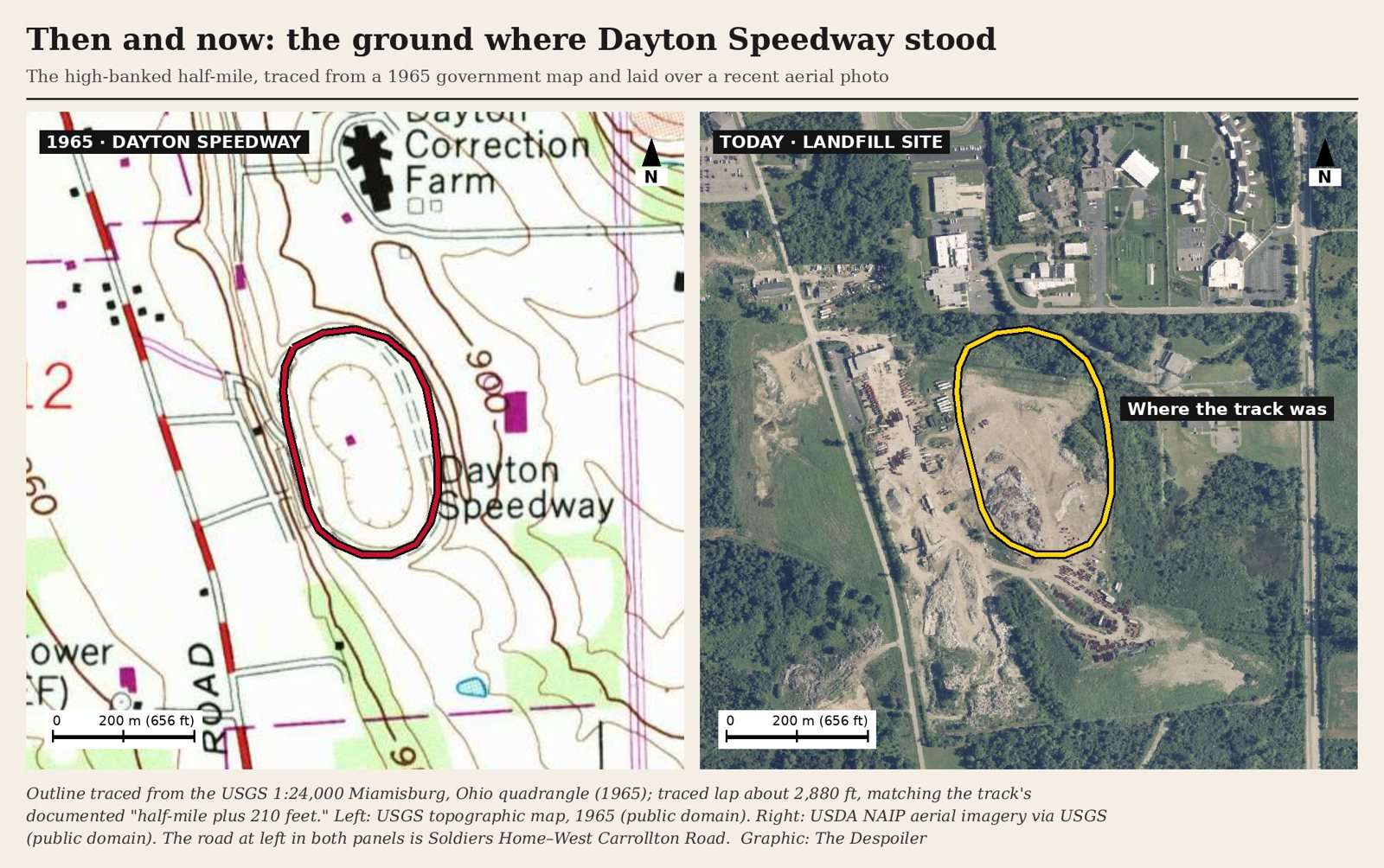
Left: USGS topographic map, 1965. Right: USDA NAIP aerial imagery via USGS. Both public domain. Graphic: The Despoiler.
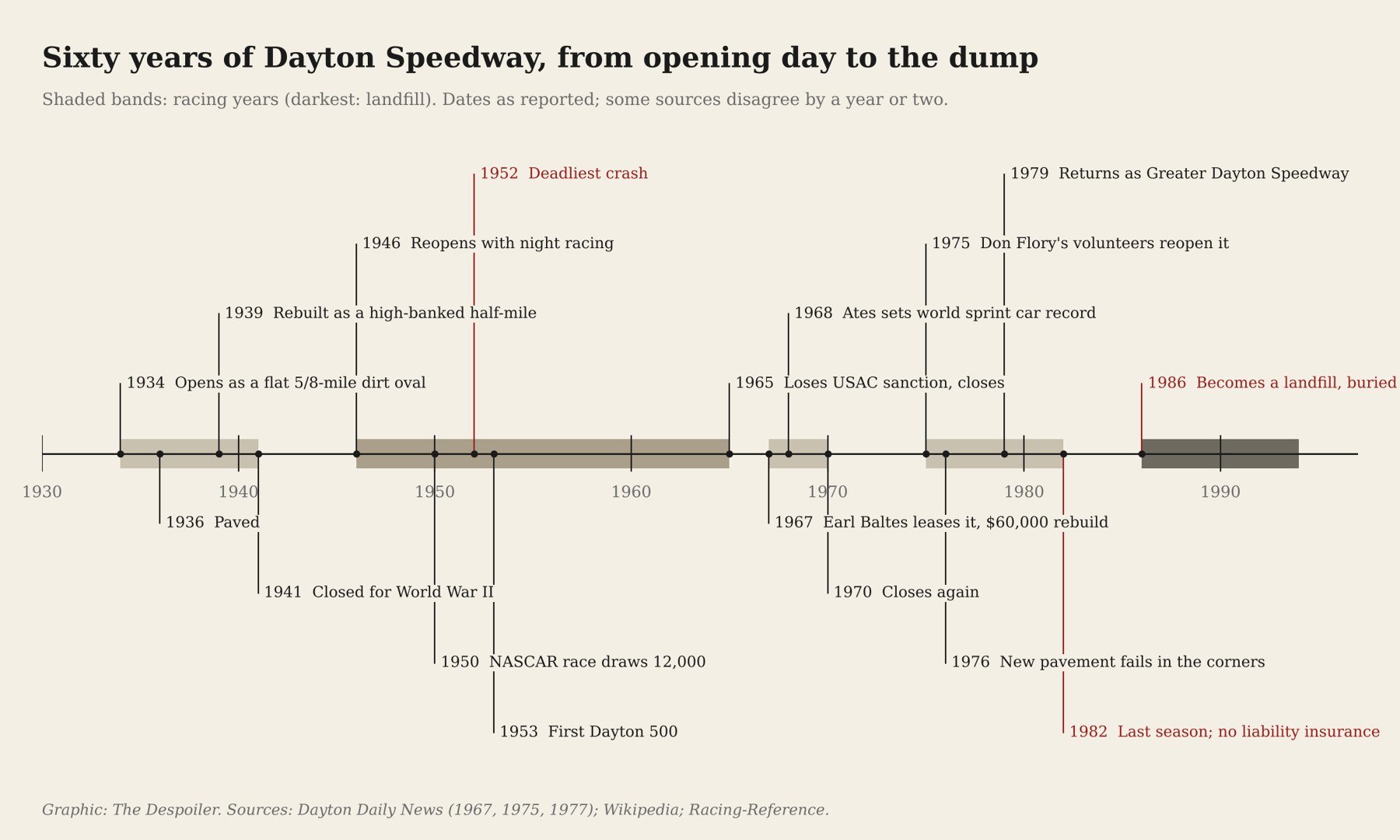
Graphic: The Despoiler.
Why build it again
- The racing roots are still here. Winchester, Dayton's sister track, is still running more than a century after its first race (Dayton Daily News). Eldora draws crowds an hour north. Dayton is the gap on the map.
- The memory is fading. Mike Thompson, who raced at the track, started DaytonSpeedwayLives.com in 2008 after a Dayton Auto Racing Fan Club meeting where only two of about 15 young drivers had heard of the place (Dayton Daily News, April 18, 2008). A new track keeps the name alive where it belongs.
- It can make money all year. The old track went quiet every winter. A new one would pair the oval with an indoor hub for karting, a racing simulator center, garages and an event hall.
- It can keep money local. The centerpiece would be a concrete bullring in the spirit of Bristol, poured by Dayton-area ready-mix producers. Concrete is also the answer to the old track's last failure: asphalt that came apart in the banked corners.
- Public money already exists for this kind of land. Ohio's Brownfield Remediation Program gave Dayton-area projects up to $1 million each in its 2026 round (State of Ohio). The Montgomery County Land Bank has $1.2 million in EPA grants to assess polluted sites (Dayton Daily News).
- Safety can be built in from day one. The old track's deadliest days came from 1950s guardrails and grandstands. A new track starts with modern walls, catch fences and insurance on the books.
More than a racetrack
A track that only opens on race nights sits empty most of the year, and that is how the old one starved. A new Dayton Speedway should be a public grounds that happens to have a racetrack in the middle of it.
- Festivals and concerts. A bowl with grandstands is a ready-made amphitheater. Phoenix Raceway turned its infield into a two-day music festival in 2023 that drew about 20,000 people (Kick in the Tires).
- A weekly market. The paddock and infield can hold a farmers and makers market on off weekends, with booths for Dayton businesses.
- Drive-in movies and car shows. The infield, a screen on the backstretch, and swap meets in the garages.
- A classroom. Teen driver safety courses, mechanic and welding training with local schools, and track days where anyone with a helmet can drive their own car at speed, legally.
- A test site. Dayton builds aircraft parts, drones and electric vehicles. A closed course with a timing system is a place to test them.
- A winter home. The indoor hub runs karting, simulator racing leagues, trade shows and events from November to March.
Events are what keep small tracks alive. When fans bought Bloomington Speedway in Indiana in 2025, they said an average race night cost about $30,000 and that special events would make up the difference on the slow nights (WFIU).
Owned by the people who use it
The old track had one owner after another, and when the last one couldn't get insurance, the whole thing went under the dump. A new one should be owned, at least in part, by the people who fill the stands and work the pits.
How it could work:
- A cooperative holds a real stake. Ohio law lets a co-op be formed for any lawful business, and each member gets one vote by default (Ohio cooperative law summary, Co-op Law; Ohio Revised Code ch. 1729). The co-op would own part of the speedway alongside the investors who put up the big money, and hold seats on the board.
- Members are fans, workers and neighbors. A membership share would come with a vote, plus perks like a season pass, pit access or a track day. The people who work there, from the flagman to the concession stand, would be members too.
- Profits come back to members. If the track makes money, co-op members share in it, the way a credit union returns money to its members.
- The land can never be flipped. The co-op's charter would require a member vote before the land could ever be sold. The landfill ending can't happen twice.
It has been done:
- About 361,300 people own the Green Bay Packers, the NFL's only publicly owned team. Their 2021 shares cost $300, paid no dividends and couldn't be resold, and people bought them anyway (CNBC).
- Seven longtime fans, drivers and track workers bought Bloomington Speedway in 2025 when it was about to be sold off (WFIU).
- In 2018, fans of a South Dakota dirt track tried to buy it through a shareholder drive that needed 3,150 people to sign on (Performance Racing Industry).
- Here in Ohio, the Sandusky County fair board bought Fremont Speedway in 2017 so one public body would answer for the track (Performance Racing Industry).
Raising the money: Federal rules let a company raise up to $5 million a year from everyday investors through an SEC-registered crowdfunding portal (SEC). That won't build a speedway alone, but it can buy the community a seat at the table before the big investors set the terms. Selling shares to the public has strict rules, so this part needs a securities lawyer before a single share is offered.
Take it off the street
Street takeovers have hit Ohio's cities hard. On March 15, 2026, Cincinnati police broke up a takeover that started on I-75, arresting 39 people and towing 65 cars (FOX19). Ohio has made takeovers and stunt driving crimes under House Bill 56, with tougher penalties that took effect in 2025 (FOX19).
Arrests stop a takeover for a night. They don't give the people behind it, mostly young drivers who love cars, anywhere to go. A speedway can, if it is built and run for them and not just for race day.
What "used correctly" means:
- Cheap, regular nights. A street-legal night every week, not twice a year: drag runs, a drift pad, a burnout box, time on the oval. Irwindale Speedway in California opened its track to street drivers for $20 a night as a takeover alternative in 2022 (CBS Los Angeles).
- Built with the car clubs. The crews who organize meets help plan the nights, so the track is their scene, not a punishment.
- Police at the track, not just on the street. Programs where officers race civilians, like the "Beat the Heat" drag races police have run in Florida, turn the relationship around (Motor Authority).
- A path up. Driver training, mechanic and fabrication classes, and a ladder from street nights to licensed racing.
- Enforcement stays. A legal option makes it easier for courts and police to tell repeat offenders there is no excuse.
What the evidence says: These programs draw real crowds. A Florida sheriff's "Take it to the Track" night pulled about 200 racers, a Georgia drag strip saw 300 to 400 new street racers in about four weeks, and police in Idaho reported fewer street races on event nights. But nobody has hard numbers proving a track ends street racing, and the racing industry itself calls it one tool among several (Performance Racing Industry). Dayton should promise a place to go, not a cure.
Where it could go
The old site is out. Landfill ground settles and gives off gas, so it can't carry grandstands. The Despoiler looked at land across the county and drew two concept plans. Both center on a 0.533-mile concrete bullring with turns banked 24 to 28 degrees, the same as Bristol Motor Speedway.
| Plan A: Kettering | Plan B: Vandalia | |
|---|---|---|
| Site | Former Delphi plant, 145 acres | I-75 and Northwoods Blvd., 302.5 acres, listed at $18.15 million |
| Road course | About 1.8 miles, with about 0.6 mile running indoors through the old 1.1-million-sq-ft plant | About 3.6 miles, a figure-eight with one bridge |
| Also fits | Karting, simulator center, garages and an event hall inside the plant | Eighth-mile drag strip, off-road short course, new indoor hub |
| Seating (estimate) | 10,000 to 20,000 | 15,000 to 30,000 |
| Biggest hurdle | The owner is readying it for manufacturing; cleanup testing underway; neighbors close by | Zoning and terrain unknown; land cost comes before any construction |
The Kettering plan is the cheaper start because the building already exists and becomes the winter half of the business. The Vandalia plan is the bigger vision. It sits next to Dayton International Airport, which has more than 500 acres available, and airport neighbors already live with noise.
The Larry Connor Victory Lane. Whichever plan wins, victory lane should carry the name of Larry Connor. The Kettering-raised businessman won back-to-back SCCA Formula Atlantic national championships in 2000 and 2001, raced the 24 Hours of Le Mans, and won the 2014 Baja 1000 with his own Team C Racing. In 2022 he flew to the International Space Station as pilot of Axiom Mission 1. At home he led the fundraising that rebuilt UD Arena (Wikipedia). Few people alive have carried Dayton's name further in both racing and flight. The Despoiler has not discussed the idea with him.
What it would take
- Land and a deal: neither site has been approached.
- Zoning and noise: the first fight for any new track.
- Federal sign-off: any use of airport land would need the FAA's approval.
- Cleanup: polluted sites need testing and a state sign-off before pavement goes down.
- Insurance and backers: the two things the old track ran out of.
Next in this series
The Despoiler will put these questions to the airport's real estate office, the Northwoods listing agent, and local concrete producers. We also want to hear from the people who kept the old track alive. If you raced at Dayton Speedway, sat in its stands or have photos in a shoebox, write to thedespoilerdayton@proton.me.
A word to Dale Jr. On Lost Speedways, Dale Earnhardt Jr. and his crew have visited 15 forgotten tracks, from Metrolina to Pennsboro to the old Daytona beach course (Wikipedia). Dayton Speedway hasn't had its turn. It has everything the show loves: a NASCAR Grand National race in 1950, the Indy hopefuls who ran "The Hills," an Earl Baltes chapter, a Daytona-steep bank, and a ticket taker who made Bill France Sr. pay to get in. The oval is buried under a debris landfill, but the 1965 map shows exactly where to stand. Dale, if you ever come looking for one more lost speedway, Dayton will give you the tour.
Sources
- Bill Clark, "Tune Up for Speedway," Dayton Daily News, April 23, 1967, p. 2-D
- Harvey Shapiro, "Speedway Goal: 1 in '75" and "The Good and the Bad," Dayton Daily News (July 6, 1975)
- Harvey Shapiro, "Problems pave the way to reopen Dayton Speedway," Dayton Daily News (May 1, 1977)
- Greg Billing, "Dayton Speedway not forgotten," Dayton Daily News (April 18, 2008)
- Wikipedia, Dayton Speedway
- Dayton Daily News, "Remembering the glory days of the Dayton Speedway"
- Dayton Daily News, "Dayton Speedway gone, not forgotten"
- Dayton Daily News, "Dayton Speedway: After owner's death, remembering the track"
- Dayton Daily News, This Week in Dayton History (1933 track announcement)
- Dayton Daily News, "100 years later, Winchester Speedway going strong"
- Racing-Reference, 1950 NASCAR Grand National race at Dayton
- Wikipedia, Bristol Motor Speedway
- AOL / Dayton Daily News, former Delphi plant brownfield grant
- Avison Young, I-75 and Northwoods Blvd. land listing
- Dayton International Airport real estate
- State of Ohio, Brownfield Remediation Program Round 11 (May 2026)
- Dayton Daily News, Land Bank gets $1.2M in EPA grants
- Kick in the Tires, Phoenix Raceway infield festival
- WFIU, race fans become owners of Bloomington Speedway (May 8, 2025)
- CNBC, Packers stock sale (Nov. 15, 2021)
- Performance Racing Industry, fans try to save Badlands Speedway (Oct. 10, 2018)
- Performance Racing Industry, fair board buys Fremont Speedway (Oct. 17, 2017)
- Co-op Law, Ohio cooperative law; Ohio Revised Code ch. 1729
- SEC, Regulation Crowdfunding
- FOX19, Cincinnati police arrest 39, tow 65 vehicles after street takeover attempt (March 15, 2026)
- FOX19, harsher penalties for illegal street activity (June 14, 2025)
- CBS Los Angeles, alternatives to street takeovers in Irwindale
- Motor Authority, Beat the Heat (May 4, 2009)
- Performance Racing Industry, "Beating the Street?" (Jan. 1, 2022)
- Dayton Daily News, Rauch was ordered repeatedly to clean up unauthorized waste
- Ohio Attorney General, Dayton-area man indicted for alleged illegal open dumping (Nov. 2018)
- Dayton Daily News, Rauch firm faces fines while boss not guilty
- Wikipedia, Larry Connor
- Wikipedia, Lost Speedways
- USGS historical topographic map, Miamisburg, Ohio quadrangle, 1965 (public domain); USDA NAIP aerial imagery via the USGS National Map (public domain)